
The Union Cabinet on Wednesday approved a Rs 26,058 crore production linked incentive (PLI) scheme for auto, auto-components and drone industry to enhance India's manufacturing capabilities, Union Minister Anurag Thakur said on Wednesday. The PLI scheme will incentivize the emergence of advanced automotive technologies' global supply chain in India.

Passenger vehicle wholesales in India rose to a record high in October as companies pushed dispatches to dealers to cater to the enhanced demand in the festive season. The overall passenger vehicle wholesales in October rose to 391,472 units, up 16 per cent from 336,679 units in the same month last year. Last month witnessed the highest-ever dispatches of passenger vehicles in the domestic market by Maruti Suzuki India and Mahindra & Mahindra.

'From data on enquiries, we can build what we call a data lake or a data warehouse where data is classified into various cohorts and then we use AI and ML tools to predict demand down the line.'

'Yet the market didn't do all that badly because it was cushioned by domestic inflows.'
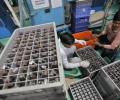
Exasperated by frequent labour strikes, the Tamil Nadu government has decided to give public utility status to Auto components makers. A move that has left labour unions fuming since, now, they won't be able to go on strike without issuing a notice of six weeks in advance.

According to industry sources, Nissan will roll-out the latest generation Micra from the plant in May for the Indian market.

The 2022-23 (FY23) January-March quarter performance of the country's largest listed paint companies was better than Street expectations. Asian Paints, Berger Paints, and Kansai Nerolac Paints (Kansai Nerolac) registered double-digit revenue growth, compared with the year-ago quarter, reinforced by strong volume/value growth. Falling raw material prices also helped the paint majors hoist their gross margins.
There was an acceptable domestic performance in India but there continues to be concerns about the Europe business and that overshadows the local performance. The consolidated revenues for the Q2FY24 stood at Rs 55,682 crore with an operating profit of Rs 4,315 crore and an operating profit margin of 8 per cent.

Global rating agency Moody's on Monday said the high commodity prices and supply chain disruptions due to further escalation in the Russia-Ukraine crisis could expose about 42 per cent of rated Indian companies to significant risks. They are mainly in the oil and gas and automotive sectors. The impact may be seen under two scenarios: first, revised base line and second being downside economic scenarios incorporating a global recession and a more severe liquidity squeeze, it said. The military conflict between Russia and Ukraine is impacting companies in Asia Pacific, adding to existing challenges from supply chain disruption and the coronavirus pandemic.

German automotive giant Volkswagen (VW) has said it will focus on the premium sedan/sport utility vehicle (SUV) segment and avoid the mass hatchback segment. "Customers don't expect anything less than a premium product from VW. "Customers expect a certain level of quality and driving dynamics. We have to stay true to that DNA. "The day we go mass, customers will reject us," says Ashish Gupta, brand director, VW India.

'Our plan to set up a semiconductor facility in India is back on the table'

'The future is about autonomy and tanking.'

Even as India overtakes Japan in automotive sales in 2022, moving to third place for the first time, oddly enough the country's biggest motor show is going to see some big hitters give it a clear miss. Some prominent automotive brands have cited high event costs, negligible returns on investment, poor event management, and unfavourable location as reasons for their reluctance to participate. Major pure-play electric two-wheelers, too, are riding past this year's edition of the Auto Expo.

'Just the amount of work which is there just to become more and more successful in banking. For this to happen you need to have leaders who understand technology.'
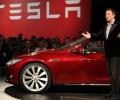
Union Minister Nitin Gadkari on Tuesday said if the US-based Tesla is ready to manufacture its electric vehicles in India then there is 'no problem' but the company must not import cars from China. In an interactive session at the Raisina Dialogue, Gadkari further said India is a large market and there is a huge potential for all electric vehicles. "If Elon Musk (Tesla CEO) is ready to manufacture in India then there is no problem ... Come to India, start manufacturing, India is a large market they can export from India," he said. The road transport and highways minister said his request to Musk is to come and manufacture in India.

Only five of India's top 20 car models have seen a reduction in wait times over the past year.

With sentiment for the automotive (auto) sector turning positive, stocks of two-wheeler auto majors have been hitting their 52-week highs. Hero MotoCorp, Bajaj Auto, TVS Motor Company, and Eicher Motors recently reached their yearly highs on strong sales in the festival season and the expectation of faster growth rates ahead. Since the start of this month, listed two-wheeler majors have delivered returns in the 12-17 per cent range, compared to the 7 per cent gains for the S&P BSE Auto Index and 3 per cent for the benchmark S&P BSE Sensex.

'Auto, pharma, and industrials have delivered well in the recent quarter, while businesses like quick-service restaurants, consumer staples, and durables have underperformed in volume growth.'

India's hiring rate has recovered moderately from 10 per cent in April to 35 per cent in May 2021, but the aftermath of the second COVID-19 wave has left professionals in India increasingly vulnerable to the economic uncertainty, as per LinkedIn data. India's hiring rate on LinkedIn dropped from 50 per cent in March 2021 to 10 per cent in April 2021. The hiring rate witnessed a modest revival to 35 per cent in May 2021, as localised curfews gradually lifted and economic activity partially resumed.

Maruti Suzuki India and Hyundai reported single-digit sales growth in July with the sports utility segment continuing to drive overall demand in the market. Mahindra & Mahindra witnessed a 29 per cent increase in passenger vehicle dispatches while Tata Motors saw a marginal increase in the wholesales last month. Maruti Suzuki on Tuesday said its total domestic passenger vehicle sales stood at 152,126 units last month as compared to 142,850 units in the year-ago month, a growth of 6 per cent.

Tata Motors on Monday said its subsidiary and Ford India have inked a pact with the Gujarat government to acquire FIPL's Sanand vehicle manufacturing plant. Tata Passenger Electric Mobility Ltd (TPEML) -- a subsidiary of Tata Motors -- and Ford India Pvt Ltd (FIPL) have today signed a memorandum of understanding (MOU) with the Gujarat government for the potential acquisition of FIPL's Sanand vehicle manufacturing facility, including land, buildings, vehicle manufacturing plant, machinery and equipment, Tata Motors said in a regulatory filing. The MoU also includes the transfer of all eligible employees of FIPL Sanand's vehicle manufacturing operations, subject to the signing of definitive agreements and receipt of relevant approvals, it added.

The limited availability of flexible (flex)-fuel vehicles in the Indian market and the slow rollout of ethanol-blended petrol by oil-marketing companies (OMCs) remain major obstacles to achieving widespread use of biofuels in the transportation sector in India. Recently, two Union ministers have emphasised India's biofuel potential, arguing that it has the capacity and potential to lead a transition towards widespread biofuel adoption. Road Transport Minister Nitin Gadkari signalled that this transition is well underway and urged car manufacturers to quickly adapt and introduce new biofuel-run vehicles, lest the government resort to taxing diesel vehicles.

Corporate India is more dependent than before on exporters of IT services such as Tata Consultancy Services (TCS), Infosys, and Wipro for earning foreign exchange. Such companies account for nearly 43 per cent of the forex revenues of listed firms, up from 22 per cent a decade ago. The listed IT services companies earned nearly Rs 4.2 trillion through exports in FY22, up 15 per cent from the Rs 3.65 trillion a year earlier. In comparison, the forex revenues or exports of the rest of the BSE500 companies were down 11.9 per cent to Rs 5.6 trillion last financial year.
After auto components major Bosch Ltd, Sundaram-Clayton, Hero MotoCorp now announce temporary production shut down

The heavy industries ministry has asked US-based electric car major Tesla to first start manufacturing its iconic electric vehicles in India before any tax concessions can be considered, government sources said. They said that the government is not giving such concessions to any auto firm and giving duty benefits to Tesla will not send a good signal to other companies that have invested billions of dollars in India. Tesla has demanded reduction in import duties on electric vehicles (EVs) in India.

The automotive business includes vehicle manufacturing plants of Ford India in Chennai and Sanand.

Amid a rush of sport utility vehicle sales, Volkswagen is betting on its premium mid-sized sedan - the Virtus - to gain market share in India. The Volkswagen Virtus is the second product under the India 2.0 project being developed on the MQB-A0 IN platform, with up to 95 per cent localisation levels. In February, the company registered an 84 per cent year-on-year growth in sales, primarily driving on the Taigun it launched last year.
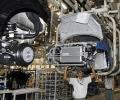
Maruti being the market leader with a disproportionately high share of the passenger car market helped its component makers grow as an industry all these years and hence, the exit from a segment is a jolt if not a big setback.

Domestic automobile retail sales rose 10 per cent in June driven by sales growth across various segments, including passenger vehicles and two-wheelers, automobile dealers body FADA said on Thursday. Total retail sales last month rose to 18,63,868 units from 17,01,105 units in the year-ago period. Passenger vehicle retail sales increased 5 per cent to 2,95,299 units as against 2,81,811 units in June 2022.

Amid better semiconductor chip supplies, the Indian automotive industry posted an 8 percent growth in production of vehicles across categories for the month of May, with three-wheelers (20 per cent) and passenger vehicles (16 per cent) leading the pack. Exports, however, dipped 21 per cent at an industry level. The industry also recorded its highest-ever May wholesales of domestic passenger vehicles (334,802 units), riding on high demand for sport utility vehicles (SUVs) and better supplies of semiconductor chips.

For Mahindra & Mahindra (M&M), which has just started executing a comeback strategy for wresting back ground it lost to rivals, this could not have come at a worse time. The maker of the Bolero Neo and the Thar models on Thursday said it would have to halt production at its automotive plant for a week due to the worsening supply situation of semiconductors.
S&P Global Ratings has upgraded its long-term ratings on Tata Motors to speculative grade 'BB' with stable outlook on earnings improvements and potential deleveraging. The ratings agency had earlier placed Tata Motors in 'BB-'. As per S&P ratings, a BB grade is less vulnerable in the near-term but faces major ongoing uncertainties to adverse business, financial and economic conditions.

With a million-odd electric vehicles (EVs) - two-wheelers, e-rickshaws, buses and passenger cars - expected to hit the road this calendar year, the shift from gasoline-powered vehicles has become irreversible. Now the question is whether the supply chain is ready for this shift. Key components - the high-powered lithium-ion battery and the cells which go with it, the electric motor, and the electronics powered by chips - account for nearly 60 per cent of the cost of an EV.

The carmaker is set to redefine SUVs with the all-new Scorpio N. Rajesh Karkera offers a peak.
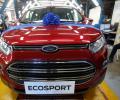
Ford, which had announced to quit the Indian market last year, said it was exploring the possibility of using one of its plants in India to produce electric cars for exports.

'Localisation saves a lot of time and cost for them. Keeping an eye on a long-term market, this is the best way these car-makers can build momentum for their brands.'
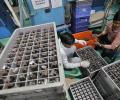
Auto component makers in India are bracing for a tough time. High absenteeism among workers owing to Covid-19, shortages of critical parts, and temporary closures of plants by automobile manufacturers have thrown a spanner in the works for the Rs 3.2-trillion sector, which derives 60 per cent of its revenues from automobile original equipment manufacturers (OEMs), with the balance split equally between replacement demand and exports. Car market leader Maruti Suzuki India on Saturday said it was extending the maintenance shutdown, which was from May 1 to 9, till May 16, "keeping in view the current pandemic situation". Some activities will continue in the plants.

Automotive (auto) and auto ancillary stocks have been in the fast lane thus far in 2023-24 (FY24), with the National Stock Exchange Nifty Auto Index surging nearly 27 per cent, outperforming the Nifty50, which has gained roughly 11 per cent during this period. The top-gear performance of auto stocks at the bourses, according to A K Prabhakar, head of research at IDBI Capital, has been triggered by the premiumisation of products across vehicle manufacturers, which has seen vehicle sales remaining relatively stable. "It is not about higher sales figures now, but about premiumisation.

'AI is not a new thing for us. We started our AI journey in 2015.'
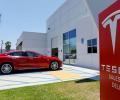
Union Minister Nitin Gadkari on Friday said he has asked US-based Tesla several times to manufacture its iconic electric vehicles in India, while assuring that all support will be provided by the government to the company. Addressing 'India Today Conclave 2021', Gadkari further said electric cars manufactured by Tata Motors are not less good than electric cars manufactured by Tesla. "I have told Tesla that don't sell electric cars in India which your company has manufactured in China.
